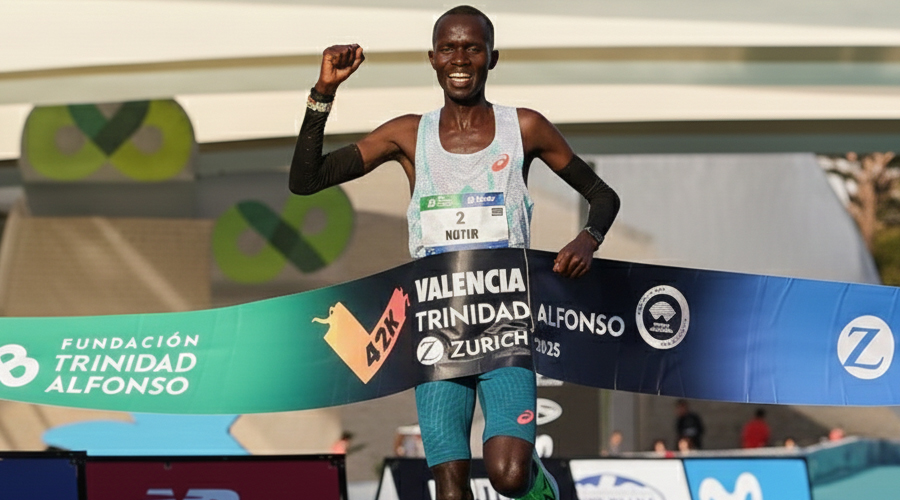
Taking the stage at this year’s Valencia Marathon, John Korir and Joyciline Jepkosgei became the two definitive figures who conquered this ultimate challenge. Earlier this year, Korir suffered a DNF (Did Not Finish) in Chicago. Many critics claimed, “Korir is done.” However, Valencia provided him with the perfect ground for a resurgence. Clocking an incredible 2:02:24, he shattered his personal best and completed the race with a negative split—meaning he ran the second half faster than the first. He is no longer just the “fallen runner”; he stands as one of the most remarkable marathoners of the 2025 season, registering one of the three fastest marathon times of the year.
Joyciline Jepkosgei – The New Reference Point in Women’s Marathons
Jepkosgei crossed the finish line in the women’s category at an astonishing 2:14:00. This was not only the fastest time of the season but also the fourth-fastest women’s marathon performance in history.
Her most formidable rival in the field was Peres Jepchirchir—a world and Olympic champion. Yet, Jepkosgei turned both emotions and the scoreboard upside down with a clinical, aesthetic surge in the final kilometer. The 43-second gap she created wasn’t just a display of speed; it was a profound demonstration of sheer willpower.
What Does Valencia Teach Us?
-
The marathon remains the most brutal yet honest race: A marathon never forgives poorly executed kilometers. Korir’s negative split strategy captures the very soul of the sport: patience + planning + redemption. Meanwhile, Jepkosgei’s triumph serves as a powerful reminder that women can reach the absolute pinnacle of endurance, freeing the marathon from traditional male dominance.
-
Global athletics is shifting gears: Kenyans weren’t the only ones claiming glory in Valencia. In the men’s category, names like Germany’s Amanal Petros (2:04:03), Norway’s Awet Kibrab (2:04:24), and Japan’s Suguru Osako (2:04:55) all shattered their respective national records. This proves that the marathon stage is breaking away from single-nation monopolies, evolving into a polyphonic, dynamic, and universal arena.
-
Marathon running now represents prestige, fame, and economics: The rewards and status earned by Korir and Jepkosgei solidify this reality. Valencia is no longer just a footrace; it is the modern gold standard for career, identity, and athletes looking to secure their future.
The Silent Philosophy of the Marathon
Valencia is not an end; it is a beginning. The victories of Korir and Jepkosgei remind us of the symbolic power of the marathon. Perhaps the marathon isn’t a race at all, but an extensive metaphor. Just like the long roads of life, there are ups and downs; sometimes you fall, and sometimes you rise.
The real question is: Can we pick ourselves back up like Korir in the marathons of our own lives? Or do we simply fixate on the finish line while disregarding the path in between? Some questions have no answers. But Valencia clearly demonstrated one thing: limits live only in our minds.
In Brief: Quick Facts in Two Minutes
-
What happened in Valencia? John Korir won the men’s race in 2:02:24, and Joyciline Jepkosgei claimed the women’s title in 2:14:00, breaking both personal and historic records.
-
Why does it matter so much? Because the marathon remains brutal but inherently fair—the past can be rewritten, and failures can be forgotten. Korir and Jepkosgei proved exactly that.
-
Is marathon running still an African monopoly? No. Nations like Germany, Norway, and Japan shone brightly with new national records, showing that global athletics has rebuilt itself as a diverse arena.
-
What did Valencia teach us? Limits are mental constructs. Embracing the risk of falling and finding the strength to rise again is what the real race is all about.